
Moving Coil and RIAA Transformers
There are several areas where signal transformers have a traditional place as the first choice component. One of those is the moving coil transformer.
Transformers for MC or microphone applications |
|||||
|---|---|---|---|---|---|
Core |
Step Up Factor |
Frequency |
|||
| Mu-Metal | 16 |
32 |
7Hz.. 70 kHz +/- 1dB |
||
| Mu-Metal CARDAS® |
8 |
16 |
8Hz..100 kHz +/- 1dB |
||
| Mu-Metal Silver Wire |
8 |
16 |
8Hz..100 kHz +/- 1dB |
||
| Mu-Metal CARDAS® |
16 |
32 |
8Hz..100 kHz +/- 1dB |
||
| Mu-Metal. Silver Wire |
16 |
32 |
8Hz..100 kHz +/- 1dB |
||
| Mu-Metal CARDAS® |
3.3 |
6.4 |
12Hz..100 kHz +/- 1dB |
||
| Amorphous Cobalt. CARDAS® |
5 |
10 |
20 |
10Hz..50 kHz +/- 1dB |
|
Amorphous Cobalt LL9226 Version with Faraday Shield |
5 |
10 |
20 |
10Hz..25 kHz +/- 1dB |
|
| Amorphous Cobalt | 16 |
32 |
10Hz..90 kHz +/- 1dB |
||
| Amorphous Cobalt. CARDAS® |
8 |
16 |
10Hz..100 kHz +/- 1dB |
||
| Amorphous Cobalt Silver Wire |
8 |
16 |
10Hz..100 kHz +/- 1dB |
||
| Amorphous Cobalt. CARDAS® |
16 |
32 |
10Hz..100 kHz +/- 1dB |
||
| Amorphous Cobalt Silver Wire |
16 |
32 |
10Hz..100 kHz +/- 1dB |
||
| Amorphous Cobalt. CARDAS® |
3.3 |
6.4 |
12Hz..100 kHz +/- 1dB |
||
| Amorphous Cobalt. CARDAS® |
12 |
24 |
10Hz..100 kHz +/- 1dB |
||
Transformers for input (and DC-free line output) applications |
|||
|---|---|---|---|
| Type | Turns Ratio | Size (LxWxH mm) | Application examples |
| LL1674 | 1+1 : 4+4 | 43x28x21 | Line input/output transformer. With Amorphous Core. |
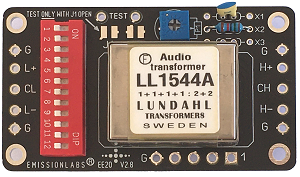
| LL1676 | 1+1 : 2+2 | 43x28x21 | Line input/output transformer. With Amorphous Core. |
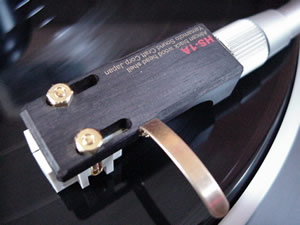
The challenge is not how to amplify the signal, but how to do this without adding noise and hum. If we would be adding only 200 micro volt noise to 200milivolt signal, this would be 60dB, which is an audible difference. However, most semiconductors already produce 200Microvolt noise by themself. For hum, the situation is even harder, because the ear is less tolerant to hum, than to noise. There are mains cables everywhere. As a matter of principle, there is always a small capacitive current flowing between each metal chassis, and whatever it is connected to. Moreover, the mains ground wire is never very clean, and it is a another source of very small unwanted current, which in unlucky cases also finds it's way into the shielding of audio cables. All in all, it is not very promising to connect a MC pick up directly to an amplifier input.
There is however a very elegant solution, and that is given by the MC transformer. Such a device solves all problems at the same time.
First, it changes the input of the RIAA amplifier to a symmetric input, even if it was not. This means, the small, capacitive AC current, which would try to flow from the metal of the record player chassis, to the RIAA amplifier input is blocked by this, because the signal path provides no ground path any more. Or in other words, the record player is galvanically decoupled from the RIAA amplifier, which means the same thing. This eliminates this very nasty source of hum completely.
Second, MC cartridges are always extremely low impedance. This is just by nature of the construction, but it can be used to create voltage gain by means of the windings ratio.
This step up factor does not have to fit exactly to the MC cartridge, but it must still be within some range. Some MC have a quite low output impedance, which means also very low output signal, but due to this low impedance, it is able to drive an MC transformer with a higher step up factor of let's say 16...32.
Others have not quite such a low impedance, but for that supply a higher signal. Due to the higher impedance, such can only drive a transformer of lower step up factor, let's say 8...16. Yet because the voltage was higher to begin with, the output voltage is still in a good range.
In the end, there is always a step up transformer, which fits to a MC cartridge, but it has to be calculated, what step up ratio we need. For this calculation, as explained above, we need to know the cartridge impedance and it's output signal. You can either calculate it yourself, or you can use an Excel sheet we have, which has the calculations inside, all LUNDAHL Transformers listed, and most of the common cartridges too. Moreover you can always add a new cartridge by hand.
About Quality of MC transformers.
For more information about amorphous materials, please click in the article link on the right, or when you use a mobile phone, you can click it also directly here:
Article LinkHow to choose the core material.
This is really a matter of taste, and honestly these are all very good transformers. So don't feel bad, choosing a low cost one, these are top quality transformers just as well. For the choice, there is absolutely nothing wrong with the engineering approach saying that any product must have lowest distortion possible. For this reason, Mu-Metal is a very popular product for the community of professional users. The contrary to this approach is using amorphous cores. These have more distinguished sound of their own, which can also be measured by analyzing the frequency spectrum. However, amorphous cores are not intended to outperform solid metal cores that way. Their performance is, they sound different. Some users love amorphous products so much, they equip the complete amplifier with amorphous transformers, including the chokes for power supply. Amorphous materials can be Cobalt or Iron, whereas Cobalt is an very expensive material with a higher frequency range.
Cardas Wire
This is a special 6-N copper wire, by the USA company Cardas, which is used by Lundhal. It features lower resistance then the standard copper wire, and also higher purity, which again greatly changes the crystal structure, the mechanical softness of the wire, and by this changes the way it is wound too. This reflects in the lower copper resistance if this type.
Silver Wire
This was introduced by Mr. Lundahl on request of several customers, around 2010. So far all our buyers were hesitating in the beginning, but each of them turned extremely satisfied afterwards. Sound was unanimously reported brighter and clearer, and fully in line with the expectations. Though we can not promise sound by email of course, at least those customer opinions I would like to report here.
IMPORTANT: How to select a Lundahl transformer, fine tuning of Moving Coil transformers, and some more information.