|
Lundahl Part Numbering System,
and
how to understand
Output Transformer datasheets
Last Revision:
23-04-2017
When I started as a Lundahl distributer, I was confused with the many part numbers, and various ways to connect the transformers. And after I understood it, I found it so easy :) Perhaps the following information will help you to get started:
Here is how the Lundahl transformers are grouped:
- Mains transformers and mains isolation transformers
- Tube output transformers
- Signal output transformers (includes tube interstage)
- Signal Input transformers
- Chokes for power supplies
- Chokes for tube anodes (plates)
Size, core, and windings.
- Miniature transformers (for digital inputs / CD Player). Example
- Small size transformers, for DC-Free signals. Example
- Medium size transformers. DC-Free or Single Ended. Example
- Large size transformers. DC-Free or Single Ended. Example
- Extra large size transformers. DC-Free or Single Ended. Example
- Some are available as pre-wired types. Those have only one input impedance and one output impedance. Example
- Some are available as multi impedance types. Those are highly recommended in case you change your speaker impedance (perhaps some day), or if you want to choose the primary impedance later, after hearing tests.The multi-impedance types have three input impedances and three output impedances, which gives many combinations, or wiring schemes, that are given in the datasheets. You don't need to understand how these work. Just pick the wiring scheme for your desired input impedance, and desired output impedance, and that's it. Going to higher impedance will give lower maximum output power, as you can see in the below table. Since tubes have the same effect, this matches nicely, and the power limitation will always be the tube, not the transformer. Example
Options
Starting from the medium size transformers, many are available in a few versions, with same price and dimensions.
- "SE" for Single ended.All types are basically the same, apart from the maximum DC current. We encourage you not to over-rate the DC current. Lundahl has already 15% hidden headroom in the DC Current specification, plus additional margin is included in that to allow maximum AC signal, and still have the 15%. So all SE transformers will work distortion-free at maximum signal, and the maximum DC current at the same time. For the rest, all SE types of one part number are all the same. So you will have LL1623/90, LL1623/120, etc. These are the same apart from the DC current and Inductance.
- "PP" for Push-Pull. With very small airgap to allow 15% DC component for tube imbalance.
- "PPZ". This option changes any PP transformer in a parafeed. (or for signal output applications). These have zero airgap, and roughly twice the inductance. Some special parafeed transformers don't have the "PPZ" added, because these are parafeed by definition
- "CFB". This transformer type has an extra winding for the cathode feedback.
Secret Tip
- I had this confirmed by Per Lundahl several times. All power chokes can be used as plate chokes or vice versa. The powes chokes are wound on HiFi core material, and winding technique is the same. So a plate choke like LL1668/25mA is a wonderfull power choke too, for instance in a phono amplifier where you work with 25mA only, and it gives you a few hundred (!) Henry.
Selection table (below)
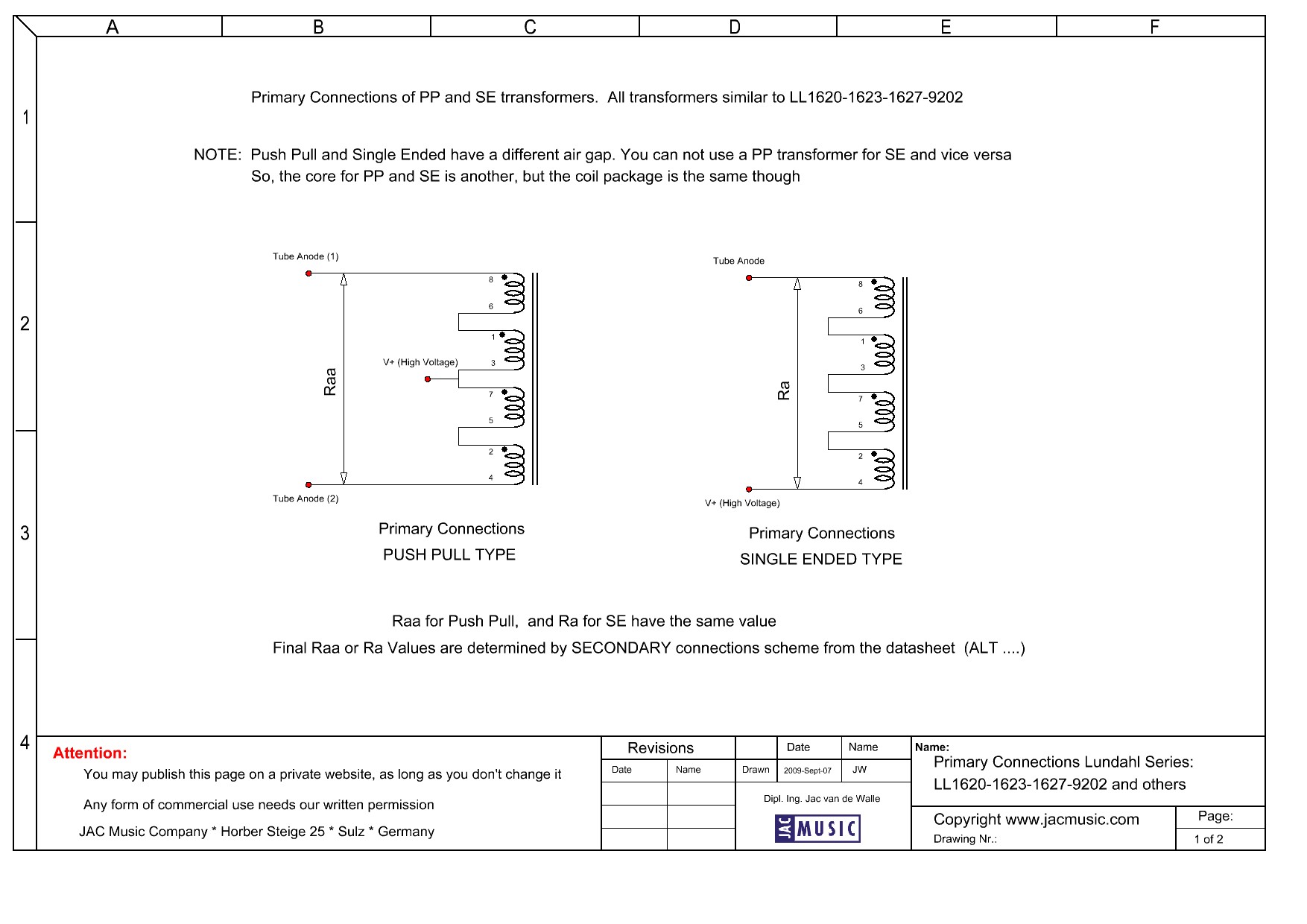
- This shows how to use the tables like this, which you will find in each datasheet. Follow the points in this order: 1, 2, 3 and you have the connection scheme you need. So in the example the line Nr 3 shows to "D" in the middle of the word C/D/E. Scheme "D" is in the datasheet of course. Check here for full datasheet example.
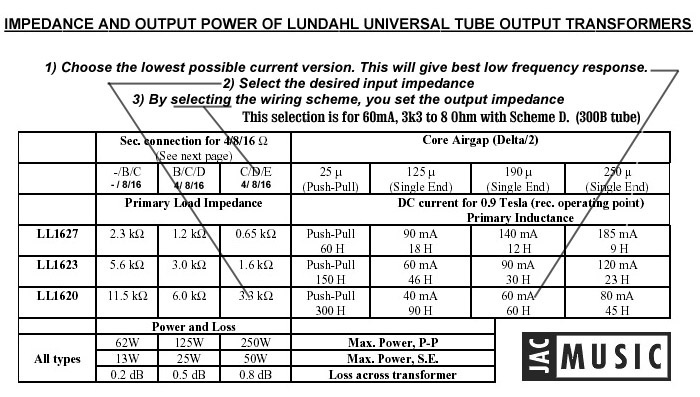
 This drawing is only for your interest, when some people want to understand how SE and PP transformers are made with the same windings package, and same impedances in the datasheet. Seting impedance and making the connections though should be done by the datasheet.
 |
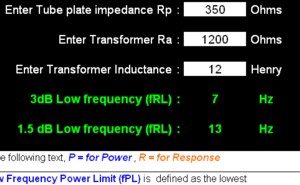
Download this very handy Excel program, to check the low frequency reponce of a Lundahl transformer. Excel program here
Hint: If you have no Excel, you should install "openoffice" from openoffice.org That will run Excel, MSWORD, all the latest versions, legally and for free. |
Is it difficult to design your own MC transformer box? No!
Here is a screenshot from the LUNDAL MC cookbook. This is not a printed book, but these are a few pages of information, you get on CD. It tells you the basics of how to design your own MC Transformer, and it has also an Excel program for some calculations.
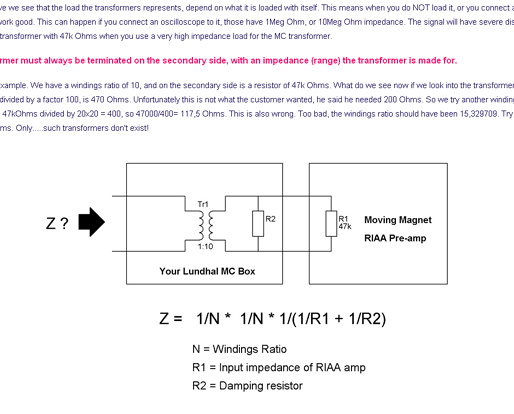
Attention! The below is a PICTURE only. When you order the MC transformer cookbook, it is on the CD as well. This Excel program is in German and in English, the MC cookbook is in English. The order number + price you find in the prcielist.
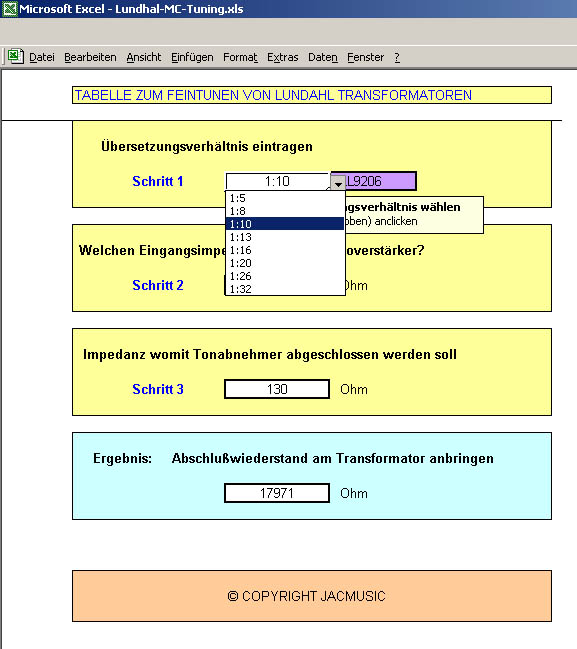
The Lundahl MC Cookbook
Copyright © JAC Music. All Rights Reserved.

|