
Interconnect solutions
Introduction
All Lundahl transformers have physically a symmetrical construction per definition. Interesting wise this has totally different advantages for each product. For the small signal transformers, a natural application is using them for symmetrical signals, and conversion of symmetrical to non-symmetrical (and vice versa).
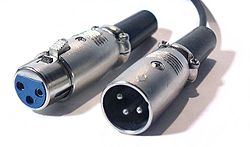
Symmetrical (XLR) connections are the best and professional way to eliminate hum problems permanently. The ground loop is high impedance with XLR, and with transformers the ground loop is not even present. Furthermore, the cables are symmetrical so they do not radiate signal and do not receive unwanted signal. Mains hum can be radiated into a symmetrical (XLR) cable, and also cross talk is like zero.
So you find this where large lengths are used, such as on a music stage. Other applications are for Studios with hundreds of connections to one panel, where cross talk and hum cannot be tolerated.
Also you find the XLS connections where HiFi users choose XLR connected equipment to permanently solve hum problems.
There are several ways to use an interconnect solution from ,undahl transformers
- Build in a signal transformer in your equipment, either at the source or at the receiving end, or at both ends. This is easy to do and generally you will choose the 1:1 option. Please check here for some more information about this. How to choose Symmetrical to unsymmetrical transformers. However, when constructing new equipment you can also consider a 1:2 1:3 or 1:4 step up. There is a lot of advantage in this, since distortion and noise of a good signal transformer is much lower than an active stage.
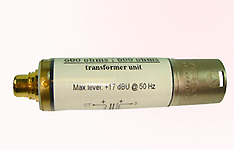
- Use a ,undahl interconnect solution with transformer inside.
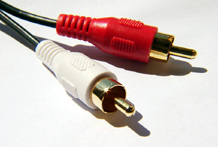
This solution can connect XLR equipment to RCA equipment, the only correct way, and that is with a transformer. The actual interconnect cable is an RCA cable, or the XLR cable depending on the connector you choose. Also with the RCA cable, inside it works like an XLR too. This is the only professional way to connect XLR to RCA.
There are several types:
|
|
|
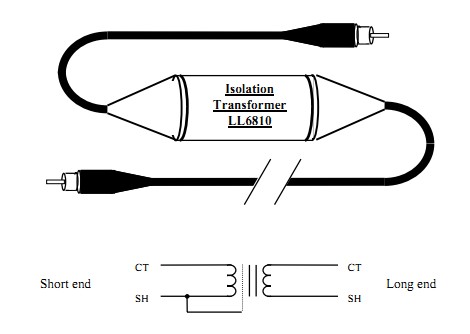
PART1: RCA to RCA / LL6810-PHMPHM / High Impedance series. Can used in both directions. For load of 10k or higher. On Auxiliary (Aux) LEVEL, as seen with most RCA connectors. Application: From Disc player to pre-amp, or from pre-amp output to Power amplifier, etc. This is the best interconnect cable ever build. Period. It s made from a very high quality ORIGINAL MOGAMI STUDIO CABLE FROM JAPAN which ,undahl is buying to make this special cable. In the Lundhal workshop, they cut the original Mogami cable in two pieces at first. Then, at the cut position, a high impedance, high bandwidth transformer is inserted, inside a brass cylinder housing. This is all done with very nice, all ,undahl made parts. The result is a universal connector cable for Audio signals, like from a CD player to pre-amplifier, or any other signal connection. Before you spend 800$ on a "magic snake" cable or other voodoo, better stay down to earth, and try a REAL solution like LL6810-PHMPHM. To help you decide, all tone studios use ,undahl cables in quantities of 40pcs or more per panel, and solve their hum problems with it! This is a very much recommended product. Order Number: 218-091-90 |
|---|---|
|
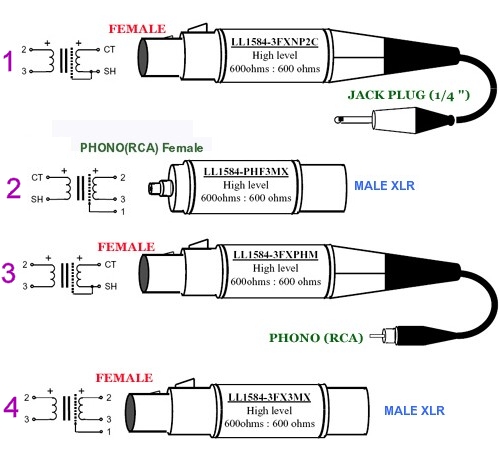
PART2: 600 Ohms - Lowimpedance Series. LL1584-xxxx Family Can used in both directions. Application: From low impedance source, to high or low impedance input. Such as from low impedance ( 600 Ohms or lower) pre-amp, to input of Power amplifier, etc. If source is above 600 Ohms, this LL1584 family cannot be used, but use LL156X family instead. LL1584 is available in four versions:
|
|
PART3: High impedance Series.LL156X Family Can used in both directions. For load of 10k or higherAvailable in four versions:
Order Number:
|
.
Application Information:
- About grounding and shielding
- Where quality and transformers meet
- What makes Lundahl transformers so special
.