© COPYRIGHT NOTICE All Rights Reserved

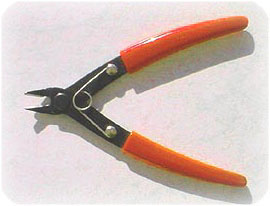 Wire Cutter Order Nr: 624-006-76 |
Wire cutter.
Simple but good version for a real attractive price! |
|
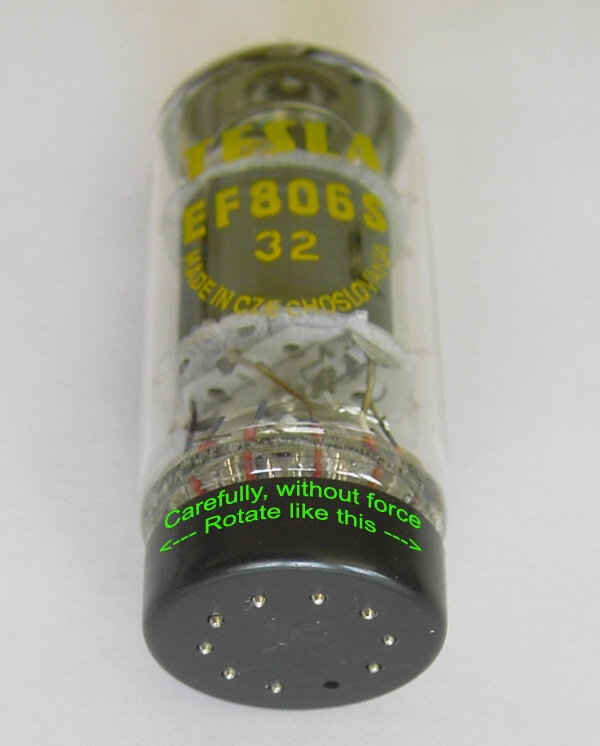 T ube pin straightener Order Nr: 699-004-33 |
Tube pin straightener For all noval tubes, like ECC81, ECC88, EL84. Made from hard plastic, so it will not damage cold coating, or scratch the pins. Note that if the tube pins are not straight, the mechanical force will or may eventually lead to loss if vacuum, you will find this confirmed in old tube handbooks. Never plug in a tube when the pins are not straight! It is not dangerous to bend the pins, but it is dangerous to leave them in a socket under force, this will cause micro leakage after months or years, and affected vacuum will cause noise, and/or defective tubes. The pin straightener must slide on the tubes without any force, and then the pins are ok. So also useful just to check the pins, and you will see many tubes you thought that are ok, will now benefit from a pin straightening action. Very strong material, can be used for hundreds of tubes.
|
|
Azimut Tool Order Nr: 620-005-73 |
AZIMUT TOOL For adjusting the azimut (on-axis) angle of the Yamamoto Wooden headshells. This is just a ultra thin hex wrench, with a very unusual diameter. |
|
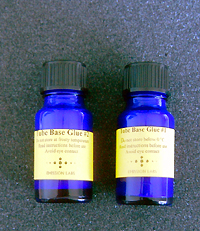
Tube base repair glue #1 Tube base repair glue #2
|
Tube base repair glue
|
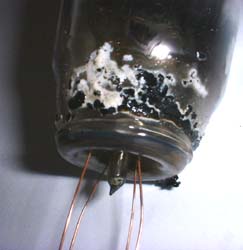
This picture shows how the Emission Labs repair glue forms a compound with the original glue. The original glue is the black particles that you see. They get weak again, and are soaked with the resin solution. NOTE, it is not normal to take off the socket; we just did so to look underneath, and see what happens. This is an old GECO rectifier tube, with almost no old glue left inside any more. Only showed here to demonstrate how the old glue is weakened again. When using the glue, you should leave the socket on. Repair Glue #1 for tube bases that are beginning to get loose, but need no filling. Repair Glue #2 for very loose tube bases that need filling compound. Attention: Not frost-proof. Do not store on a cold place. For the rest, it can be stored for several years, but after long storage you need to mix it thoroughly, particularly glue #1. |
Silver Flux Order Nr: 610-007-76 |
Silver flux. This flux can be used for silver solder or normal solder. It is a resin flux, thick liquid like honey. The bottle has a small brush. Very helpful is to "paint" contacts and solder joints before you start. As you may have noticed, lead free solder flows not as pleasant as the old fashioned lead containing solder. With lead free solder, the flux burns faster, and when it's gone, the solder joint will burn. What you do, if this happens, just let the joint cool down, brush a thick layer of this flux on it, and resolder it again. This flux will make the solder bright and clean again as soon as it get warm. This is pure resin flux, no aggressive chemicals added. After soldering the residue can either stay on the components, or for optical reasons be removed with alcohol. 10ml Bottle. |
|
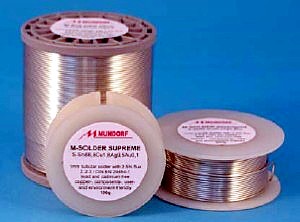 Silver Solder Silver SolderOrder Nr: 611-001-87 |
Mundorf Silver-Gold solder. Specifications: Sn95,5 Cu0,7 Ag3,8 Au. Melting point 217°C Is said by Mundorf to contain a trace of gold, however the quantity of the gold is unspecified. Contains Flux. 100gramm roll |
|
| Silver-Gold Solder SUPREME Order Nr: 611-003-09 |
Silver-Gold solder. Mundorf SUPREME. Mundorf Sn88,6 Cu1,8 Ag9,5 Au0,1 Melting point 290°C. Contains 9.5% Silver and 0,1% gold Contains Flux. 100gramm roll |
|
Follow @emissionlabs
© COPYRIGHT NOTICE All Rights Reserved