Subscribe or unsubscribe our Mailing List
©www.jacmusic.com  All Rights Reserved

2B or not 2B ECC803S

We want to talk here about the ECC803S, and about the confusion with this tube.  The best  triode in the world, is by no doubt Telefunken ECC803S.    So... many talk about these tubes, know something but not all,  and fantasy the rest.  This hype is fed by manufacturers selling you an "ECC803S" which do not deserve this type number.

Basically for HiFi purposes,  a  REAL ECC803S must show these things:

  1. It is a FRAME GRID tube.
  2. It has less than 15%  plate current difference, clearly written in the datasheet.   So they are "balanced" per definition.
  3. 10k hours lifetime,  clearly written in the datasheet. 

You must be interested reading this, otherwise you would have clicked this boring text page away :)

Let me explain here what a frame grid is, and what's so nice about it. Perhaps you have opened up an old radio tube, and removed the grids one by one. When you touched them with your thick fingers they were damaged. Specially the very fine ones. Well not so with a frame grid! With a normal (none-frame) grid, the grid wires are used to keep the grid bars in position, right? This may seem kind of natural, but there are other ways to do it. A non-frame grid needs a minimum diameter (=strength) of the grid wires. If they get too thin, the grid would get too sloppy. However for miniature high gain tubes, you need thinner than thin wires, and for high transconductance you need them closest to the cathode. Here is where frame grids come in. So they make first a FRAME from hard metal, mostly Molybdenum. The frame stays inside the mica. Around this frame the grid wires are wound. This method allows extremely thin grid wires. You will think: "So what?" Well.. for HIFI something very very nice comes in, and THIS is why people like frame grid tubes so much. Frame grid tubes have a very interesting kind of microphonics. Look at a guitar... the thin strings give the higher tones. And of course more tension makes the tone higher... and shorter strings have higher tones too. Now in a subminiature frame grid tube, like TFK or TESLA, all these things come together. The wires are so thin, and tension is so high, and they are so short, that they have a resonance frequency above 20.000 Hz. This makes when you knock on the Audio frame grid tubes like TFK ECC803S, you hear not "dingggggggg" as only any regular ECC83, but you hear only a dumb noise like "zmb" and that's it. The tube will never environmental noises, no matter of the gain is 100x. Once you experienced the difference, you will ask with any tube: "Is it a frame grid tube". Well unfortunately the answer is "No" with most of the tubes. And now you understand why I say, some manufacturers feed this hype with non-frame grid tubes.

So, to reduce the confusion,  here is a nice overview of what is available.    Always keep apart the CONSTRUCTION and the BRAND and the part number, as these are different things, and you CAN get confused easily. .

We are only interested  in the construction here,  not so much under which brand it was available, and not what great parr numbers they stamp on regular tubes.  The brand is only on the outside,  but the thing to find out what's inside is by looking into it.     

First there is the Philips Long plate.  As we say, the baby called "success" is claimed by many fathers.   You see this tube on position  5 and  7.  Because it's so successful, it is found in the family of Valvo, and SEL, and Siemens, and many more.  Telefunken had a similar baby,  but from their own production.    These are on position 1 and 2. It's a good tube, but no frame grid.

The Telefunken ECC803S is a special tube.   It is a FRAME GRID tube,  in German called "Spanngitter". This is where the "S" comes from. The FRAME GRID allows extremely thin grid wire, and extremely small distance between grid and cathode.  Besides the grid dimensions are very precise.  Ideal to make a high gain miniature audio tube.  Only making frame grids is not everybody's business, and so far I have seen this technology only at TFK and TESLA.

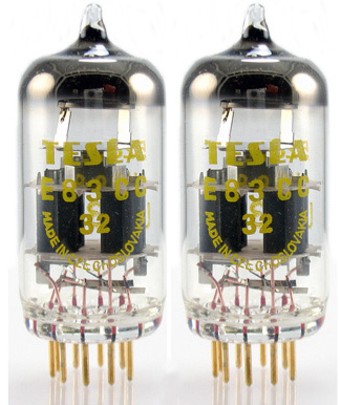
You can recognize the frame grid tubes by the typical shape of the plates, and of course by the frame grid.  The plates of frame grid tubes reach go extremely close to the grid, and this is done by the "pit" you see stamped in the middle of the plates. So the plates are kind of boxed always, and there is a put in the middle. Look at position 3,  this is the TESLA frame grid version. So it has those short, cubicle shaped plates. You think you see a  large plate distance, which is not true.  The real plate distance from parts of the plates in the middle which actually come every close to the grid.    

Frame grid tubes are more precise, and more expensive.  Normal grid can be made with thinnest wire of  100u.  Would you use thinner wire, you get unstable constructions.   For manufacturing a frame grid tube,  first a frame is made, and around the frame a 10u wire can be wound. Note, that this is thinner than the human eye can see. First tine you open up an old frame grid tube, you need some adaptance, you only see a gray"foil" kind of layer. These are the wires actually which are too thin for you to see.

This picture was made by my friend and customer ALEXANDER  KRIEGEL ( I added the Mullard M8137 to it).

From left to the right, frame grid tubes are marked BLUE: 

  1. TFK ECC83   (Long Plate) NO FRAME GRID TUBE
  2. TFK ECC83   (Long Plate) NO FRAME GRID TUBE
  3. TESLA E83CC   (Frame Grid)
  4. TESLA ECC803S    (Long Plate)  (32 = PRAGUE) NO FRAME GRID TUBE
  5. VALVO E83CC RED SERIES   (Long Plate) NO FRAME GRID TUBE
  6. TFK ECC803S   (Frame Grid)
  7. VALVO E83CC   NO FRAME GRID TUBE (Long Plate)

Now  TESLA did something strange and a bit silly,  and everybody is still today confused about it.     They REVERSED the part numbers for frame grid and normal grid tubes.    It is crazy. So they even put the "S" on a normal long plate tube.

There is the LONG PLATE TESLA VERSION, which is NO frame grid, but called ECC803S.  
There is the FRAME GRID TESLA VERSION,  but  called E83CC.
Don't try to understand the logic of this. There is none.  It is Czech humor.  Just work with it the way it is!

Frame grid tubes are more precise, and more expensive.  Normal grid can be made with thinnest wire of  100u.  Would you use thinner wire, you get unstable constructions.   With a frame grid first a frame is made, and around the frame a 10u wire can be wound. 

TFK ECC83:    LONG PLATE        -------  TESLA EQUIVALENT   ECC803S
TFK ECC803S:  FRAME GRID       -------  TESLA EQUIVALENT   E83CC

So at TESLA they  REVERSED the TELEFUNKEN PART NUMBERING.

Everybody is (still) so confused by that. 


JJ makes reproductions of all TESLA tubes. So they also copied this WRONG part numbering system, without any need.  So with JJ,  their ECC803S is a  normal  long plate tube, with an "S" on it which means nothing, and also has NOT  the points as mentioned  at the beginning of this page.  I found the JJ tubes to be less good balanced than the original TESLA.


Conclusions:

  1. TFK ECC803S is the queen of high gain miniature triodes. Absolutely impossible to ever re-build it. Top class NOS Prices of those were 100€ in 1999, then soared to 200€ in 2004. Now, in 2008 they cost 500€ (or more). Just wait until someone pays 1000€ for one.
  2. To my opinion  TESLA  (NOT JJ)   E83CC frame grid tubes are the BEST you can buy, when you do not want to spend so much on Telefunken tubes. These are fully identical construction, and on same level with the TELEFUNKEN  ECC803S tubes that they are cloned from.  Same kind of price race here, but on lower level.
  3. JJ are low budged tubes, with all that belongs to that.

WARNING FOR FAKE TUBES. DON'T LET SOME HONG KONG EBAY SELLERS FOOL YOU WITH SO CALLED ECC803S, THAT ARE FAKE. NOW THAT YOU KNOW TO LOOK AT THE CONSTRUCTION ONLY. LOOK HERE FOR SOME PICTURES.


the real ones.. :)