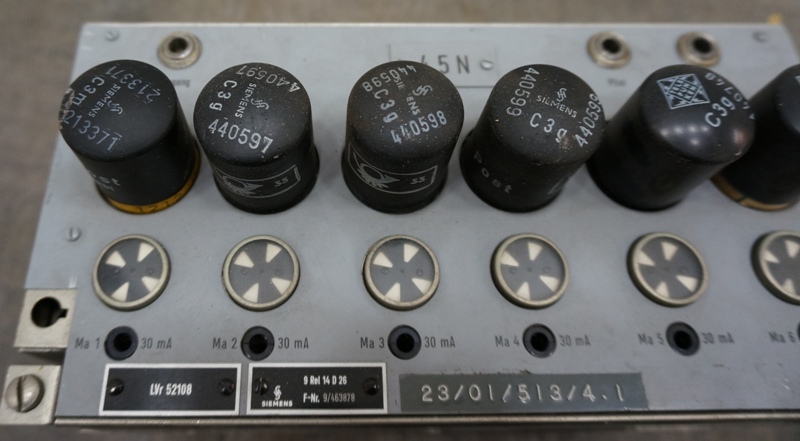
Subscribe or unsubscribe our Mailing List Information about C3g, C3m, C3o. Perhaps the best small signal pentodes ever made. The "3" I believe is to show they are third generation post tubes. These were low noise audio tubes, made by Valvo, Siemens and Telefunken, exclusively for the German post. SEL (later ITT-SEL) provided their telephone electronics to the German post, and the tubes were private branded for ITT, but still made by either Siemens or TFK. (As they all are). The TFK have a nice logo stamped into the metal. Most have a banderols on it, with a series number, but not all of them have this. These were not for sale for other customers. They were used in repeater amplifiers for long distance telephony.
Admitted, in the steel can they are not glowing so nice, but once you feel these tubes get warm, you start to see them as tubes also. Who can remember the 1970's with a long distance call from Europe to the USA? A call cost you 5$ per minute, and still the voice on the other end was not loud enough, there was a lot of noise on the line, and a one second delay. So you started to speak very loud into the phone, but that didn't help much, and I remember people in the offices would (try to) look important, by shouting into the phone with long distance calls. Anyway this is not what good signal transmission is about, but it was the limits of what was possible with ocean cables. If there is one enemy of a long distance call, it's low signal and noise. The problem is, a long distance telephone cable is a noise generator, and an attenuator too. So after a certain length, the noise gets more and signal gets less. This limits the length of a telephone line, and simply amplifying the low signal that comes out, would not help since you can't get rid of the noise. So the only solution is, to re-amplify the signal before it gets too noisy. So they increase the maximum length of a cable if by putting in repeaters, that increases the signal before the signal to noise ratio gets really bad. Imagine the trouble with repeaters in salt water, with a 4000 meters column of water pressure on it, inaccessible for ever, somewhere between Hawaii and Paris, on the ocean bottom. Going further back to the 1960's, this had to be done with tube equipment. Of course they tried to use as little repeaters as possible. The ideal repeater amplifier adds no noise, has no distortion, draws no current, is very small, and needs no service. A partial solution you get from adding an auto transformer (Pupin coils) at certain distances, but there comes a moment where you need active amplification. So the engineers desired the "ideal" tube. However these ideal requirements do not go together well: High Amplification, low noise, long life, no distortion, small size, low filament power. As most of you know, a tube with more heater temperature will have better electrical performance, and more lifetime, but uses more power too. So the solution is a bit more complicated than you might think. Tubes that meet all of the requirements are masterpieces of design, and non-commercial since they are EXPENSIVE. The price of C3g was 295DM for one tube. So that's about 200$ for one tube. In those days you could buy a new car for 5000$. So a standard 50-Pack of those had the price of two new cars. Obviously, cost was no issue with those, and that's logical since with those you could for instance work with a cable that had a bit higher loss, and add repeaters inside to compensate that. Imagine 1000km (1 Million meter) of cable can be made 20% lower cost, who cares if the tube that makes this possible costs 200$. This is the world of C3g, C3m, C3o. I think most of the secrets of how to make C3-tubes are gone with the wind, but at least we can still buy those miracles of tube art from new old stock. If the days come where we only can buy used one, it's no problem too, since the end-of-life is clearly specified in the data sheets. So you can always tell if the tubes are still good. I found the Funke W19 tester very reliable in picking out used tubes with good lifetime in it. These German post tubes were first designed in the heads of the amplifier engineers, that finally wanted to have something without compromise. The engineers just said, what must an ideal tube have, and then let the tube factories try to make it.
NOTE that in the 1980's when tubes were obsoleted, there was a lifetime-buy option by Siemens for the German post. It stretched over a few years. It is from this period that BIG lots of tubes were made, and just stored for later service of old hardware. Because of the high manufacturing numbers, these were very good quality. Popular tubes were C3g, C3m, and also Siemens ECC801S of remarkable good quality. Probably many other tubes as well, it's just these three types I ran across myself. Something similar happened in the USA, and from that period many very good 6922, 5687, 12AT7 and 5751 are around. These are those tubes with a barcode label on them. Then, the whole hardware developed so quickly after the digital multiplexing was used, and analog repeaters were taken out of service everywhere sooner than expected. And so, a six digit number of those tubes were stored and never used. Through the years these were sold, and it seems the German government stocks of C3g and C3m have dried up since 2005 or so. However, these tubes are always somewhere, and find the path to their end user. Check for a 16 pages (!!) Data sheet at our website / under Techcorner I guess they came up with some more nasty things, that the tube manufacturers all had to comply with. Just look at how nice the triode connected curves are. These curves are so linear, I think there are very few triodes excising with such nice curves! What to do, if you don't like the metal cap? You can take off the metal housing, and inside is a very nice glass tube!
C3g, C3m, C3o, what's the difference? C3g was made after C3m, and C3g has a frame grid and gold pins. Frame grids generally give better quality tubes, though it must be said that the quality of C3m is just as superb, and I make the statement here for C3g and C3m, that there is no better tube available of the same kind. If you think I am wrong, email me with facts from a data sheet, and if you find a better tube, I will add it here. Generally with C3m and C3g it can be said they have the gain of a pentode, and distortion same as only the finest triodes like E80CC. However C3m will give that low distortion at a gain of 78. (and E80CC only at a gain of 25). A gain of 78 It means you can drive a 300B with just one C3m, and you have less than 1V input sensitivity. In a few words, this explains why these tubes are so great for HiFi purposes. For applications like pre-amp tubes, or driver tubes for 45 or 2A3 the C3g can be used as well. They show their extreme low distortion only as pentodes. They can be used triode connected, but then gain comes down a lot, and the distortion increases to a level just below triodes like 6SN7.
Gain of the C3g vs. C3m C3o is a C3m with 6.3V filament. However C3o is exceptionally rare as NOS tube. C3g C3m SPECIFICATIONS (LIFETIME LIMITS IN RED) There is "S" Version of the C3g that is said to me to be selected for higher minimum transconductance. The seller is a retired production employee, who traced down big lots of C3g and C3m to where they were originally sold to, and actually found some. So I can say I have them from the first owner. However I can find no information about the "S", other than what I am told, and other than what is on the tubes and tube boxes. FOLLOWING I noted myself. The Telefunken and Siemens have the "S" stamped on the boxes, but not on he tubes. This would logically mean, these are selected out of normal production. One exception are the VALVO. These have this designation" C3g/s" also in original white paint on the tubes itself too. At least this proves to me, this is something real, and not some apecial action done, for some customer. Also it must have been a big customer. I have such tubes from Siemens, TFK, and VALVO. Do not pay too much attention to this now, I will make accurate measurements later, when I have the AT1000 set up for C3g, and then I will see what is the selection is exactly about.
Build a pentode pre-amplifier stage with C3m Take a normal Cathode resistor stage, and use this table. Good applications for these tubes are:
From the fact they both exist, you can see they both have their justification. So don't ask which one is "better". Same as with ECC81, 82, 83, there is c3g and c3m.
Some small note about small distortion. As pentode, it has distortion figures compare with E80CC, but at much higher gain. (at 5Vrms out, E80CC has, with bypassed cathode, a gain of 25 and 0,16% THD. C3m has a gain of 78 and 0,12% THD).
Data sheets. can be found in the tech corner of this website (From the menu) Subscribe or unsubscribe our Mailing List |
|||||||||||||||||||||||||||||||||||||||||||||||||||||||||||||||||||||||||||||||||||||||||||||||||||||||||||||||||||||||||||||||||||||||||||||||||||||||||||||||||||||||||||||||||||||||||||||||||||||||||||||||||||||||||||||||||||||||||||||||||||||||||||||||||||||||||||||||||||||||||||||||||||||||||||