
Since 1993 Copyright Notice
Electron Engine ™
Printed Circuit Boards by Emissionlabs.
EE50 and EE51 Moving Coil Boards
Introduction
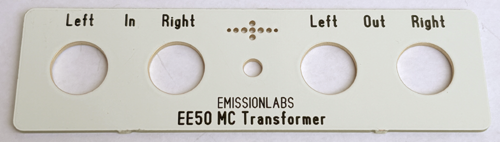
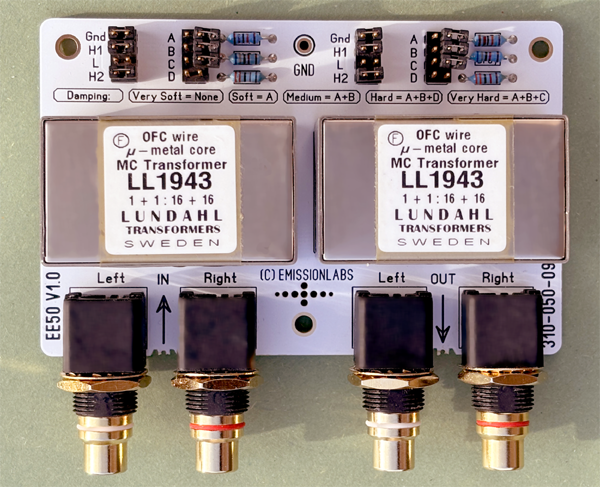
EE50 can work with most Lundahl small and large size transformers. EE51 is electrically identical, but it is designed for smaller size, and it can work only with small size transformers. EE51 is only available as pictured. EE50 includes a break-off front plate, and is available as DIY kit, or partially build.
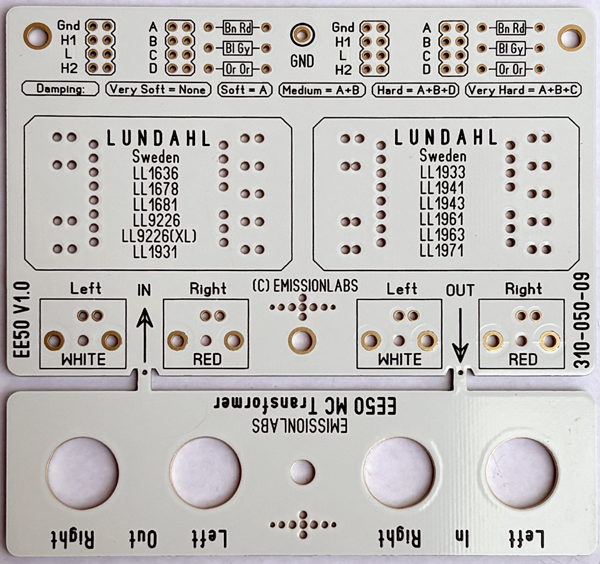 EE50 for large and small transformers |
|
LL1636, LL1678, LL1681, LL1931, LL1933, LL1941, LL1943, LL1971, L9206, LL9226XL |
LL1636, LL1678, LL9226 or LL9226XL |
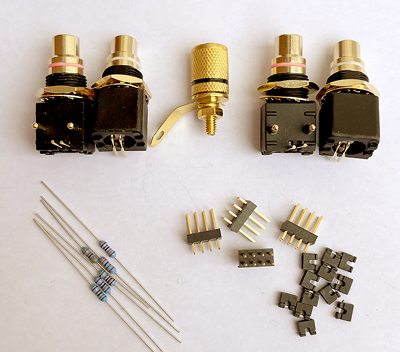
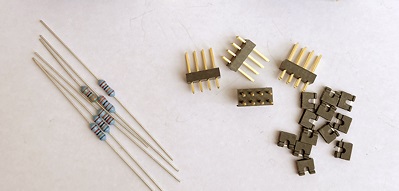
Gold plated PCB + small parts + RCA connectors Gold plated PCB + small parts, but without connectors |
|
Dimensions of PCB without connectors: 104 x 67mm |
Dimensions of PCB without connectors: 94 x 60mm |
Transformers must be ordered separately. Housing not included |
|
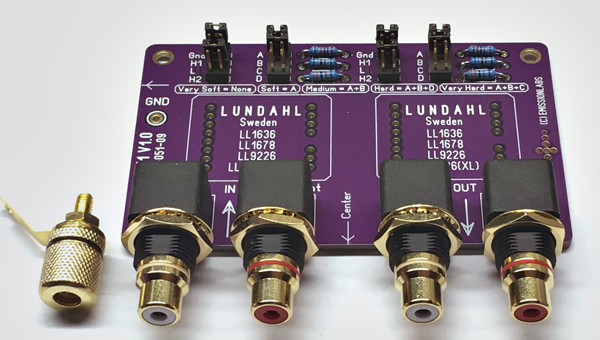
Features:
- Each transformer offers two gain two steps.
- The ground lift option can be used with shielded transformers.
- Needle damping is adjustable in five steps, from very soft, to very hard.
- RCA connectors, Jumpers, Ground connector and PCB is gold plated.
- The jumpers are a special high contact force type.
- The resistors are low noise, metal film.
- You can use your own housing, or use Hammond Box 1590B3 in which the PCB fits nice.
Pictures: EE51: With LL1636, With LL1678, With LL9226XL
Gain Settings with Jumpers H1, H2, L
Line |
PCB |
Input |
H1+H2 |
L |
Core |
Characteristic |
Ground Lift |
Frequency |
01 |
EE50, |
1:20 |
1:10 |
Amorphous Cobalt |
Lundahl's only MC transformer with internal Faraday shield. Best product for environment with a lot of mains hum. | Closed or open. If open, shield is activated. | 10 Hz--25 kHz @1dB | |
02 |
EE50, EE51 |
1:32 |
1:16 |
Amorphous Cobalt |
High Gain | recommended Closed | 10 Hz--35 kHz @1dB | |
03
| EE50 |
LL1931 | 1:16 |
1:8 |
Amorphous Cobalt |
Wound with 6N 'Cardas' wire. Best Sound of Amorphous. | Recommended Closed | 10Hz--100kHz @1dB |
04 |
EE50 |
LL1933 | 1:16 |
1:8 |
Amorphous Nickel |
Wound with 6N 'Cardas' wire. Also amorphous sound, but cleaner as cobalt. | Recommended Closed | 8Hz--100kHz @1dB |
05 |
EE50 |
LL1681 | 1:26 |
1:13 |
Mu Metal |
Much preferred product by professional users. Has internal shield, for very low hum. Neutral sound. | Closed or open. If open, shield is activated. | 7Hz--55kHz @ 1dB |
06 |
EE50 |
LL1941 | 1:32 |
1:16 |
Amorphous Cobalt |
Wound with 6N 'Cardas' wire. Best Sound of Amorphous. | Recommended Closed | 10Hz--100kHz @1dB |
07 |
EE50 |
LL1943 | 1:32 |
1:16 |
Amorphous Nickel |
Wound with 6N 'Cardas' wire. Best Sound of Amorphous. | Recommended Closed | 8Hz--100kHz @1dB |
10 |
EE50 |
LL1971 | 1:24 |
1:12 |
Amorphous Cobalt |
Wound with 6N 'Cardas' wire. Best Sound of Amorphous. Has internal shield, for very low hum. | Recommended Closed | 10Hz--100kHz @1dB |
11
| EE50, EE51 |
1:20 |
1:10 |
Amorphous Cobalt |
Just an older type, but very good transformer. You can use it with EE50 when you have a pair around. | recommended Closed | 10Hz--90 kHz @ 1.5B | |
12 |
EE50, EE51 |
1:20 |
1:10 |
Amorphous Cobalt |
One of the best transformers. | recommended Closed | 5Hz--100kHz @ 1.5dB | |
13 |
EE50, EE51 |
1:20 |
1:10 |
Amorphous Cobalt |
Top model version of LL9226, with less loss, and less distortion. | recommended Closed | 4Hz--90kHz @1.5dB |
.
| Explanation page: To choose between MOVING COIL transformers |
Damping Settings with Jumpers A, B, C, D
This is for EE50 and EE51
Damping |
|||||||||
Cartridge Load at 1:10 |
Cartridge Load at 1:16 |
Cartridge Load at 1:20 |
Cartridge Load at 1:32 |
||||||
A |
B |
C |
D |
Gnd |
|||||
Very soft |
-
|
-
|
-
|
- |
X
|
470Ohms |
184Ohms |
118Ohms |
46Ohms |
Soft |
X
|
-
|
-
|
-
|
X
|
390Ohms |
152Ohms |
98Ohms |
38Ohms |
Medium |
X
|
X
|
-
|
-
|
X
|
320Ohms |
125Ohms |
80Ohms |
32Ohms |
Hard |
X
|
X
|
-
|
X
|
X
|
280Ohms |
109Ohms |
70Ohms |
27Ohms |
Very Hard |
X
|
X
|
X
|
-
|
X
|
190Ohms |
74Ohms |
48Ohms |
19Ohms |

Ground Lift Option with Jumpers Gnd
Function of the Gnd Jumpers:
If Gnd Jumpers are inserted, Input Ground and Output Ground become connected to each other, which is the normal use.
If Gnd Jumpers are removed, the primary and secondary becomes isolated from each other, which is only needed for for failure finding, or for using the special LL1636 transformer, which has a Faraday shield. LL1636 is used for very difficult environment.
There are two Gnd jumpers, these either must be BOTH inserted or BOTH be removed.
Needle damping Setting
Too much damping gives loss of high frequency, and loss of stereo information, which is embedded mainly in the high frequency range. That is because faster needle movements (as needed for high frequency) get damped a lot more. The stereo information is coded in the vertical needle movement, which get damped just as well.
Not enough damping leads to reduced groove contact during loud sound parts, which is a form of distortion. Because of the V-shape of the groove, the needle will be forced a little bit higher up in the groove, which is not where it should be. In severe cases it can even cause the needle to skip a groove with very loud music parts. This is mistakenly judged sometimes as a bad adjustment of the tone arm. Though increasing the needle pressure may also help, you would be curing it at the wrong place.
This is why we recommend to take as much as possible damping, but not exceed the point where you begin to loose high frequency. If that happens, you would also loose stereo information. The only good way is simply try it out. Here is some more information about needle damping.
Note: The Jumper A is used for the settings as you can see. But in fact, it switches the damping of the EE51 on or off. When off, this leaves only the damping of the RIAA amplifier, which is always a "Very Soft" damping. For instance, when set for "Hard", with jumpers A-B+D, just by removing Jumper A, you go from "Hard" to "Very soft". Like this you can quickly compare the effect, while playing music. This works for the other settings as well.
Settings for some cartridges
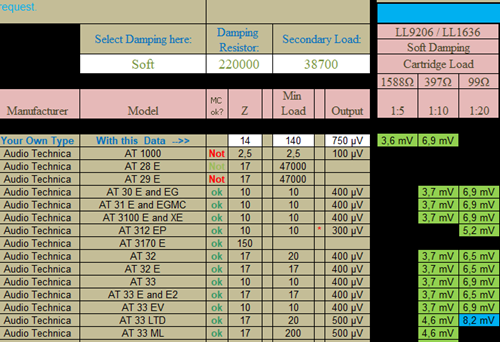 EE50 and EE51 boards work with most cartridges needing a gain from 3x to 32x.
PART2. Building information:
 The smaller size EE51 fits exactly into Hammond case, type 1590B3 (116x77x38mm). This nice box, you can order it in five colors. Or, take any other box you like. The slightly larger EE50 fits in Hammond case 1590BBS (120x94x42). This is blank metal. It can be ordered in color too, for instance for green, add GR, and the Hammond Number is 1590BBSGR.
NEVER test an MC transformer with an Ohms meter. This will magnetize the core permanently, and sound will be distorted. For this reason, buying second hand MC transformers, we strongly recommend against it. For testing, connect a small AC signal to one of the coils, and the windings ratio must appear on the other coils.
Grounding:The PCB is has a ground plane on each side, which are both connected to the "Gnd" connection of the PCB. This "Gnd" connection of the PCB should be connected with a wire, to the ground plug of the metal case. If the chassis is colored or surface treated (such as passivated aluminum), remember to clean the metal beneath the screw
In addition to the four RCA Connectors, the metal case needs also a ground screw at the outside, which connects to the record player, with a simple single wire. Since Dec 2023, this ground screw is also provided, a nice gold plated version.
Fault finding hints
 This MC unit designed to work right away. If there is hum however, the EE51 board has a some modes for fault finding
A project by Bratislav S. from Serbia, Belgrade.
Please note, we only sell the EE51 unit at the inside. Our customer send us these nice, inspiring pictures of his EE51 build.


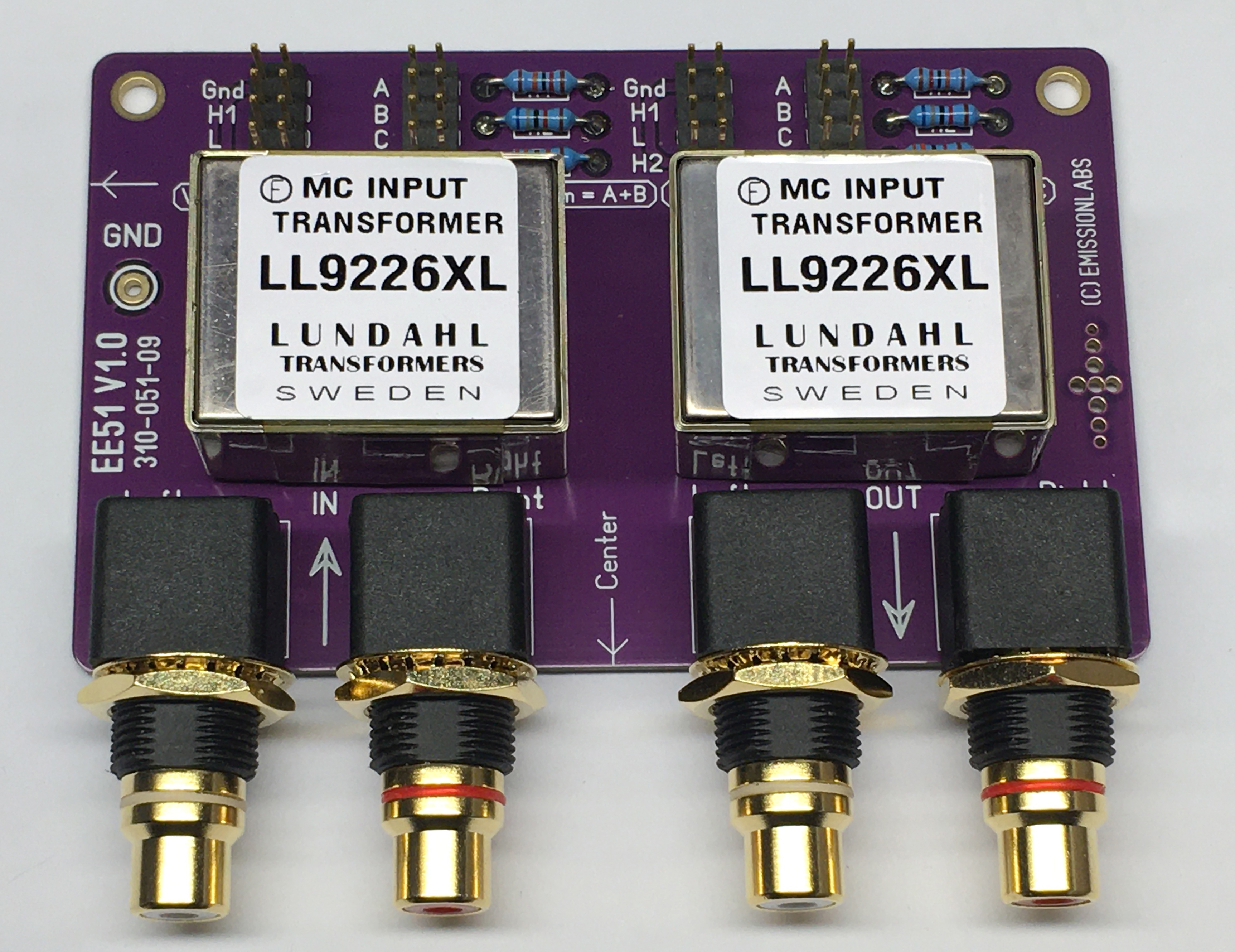


Thank you Bratislav!
Drilling holes for the connectors
 Above each connector is a dummy hole in the PCB. This can be used as template for the drilling holes. Here is a hint you may like: When drilling holes in Aluminum, use alcohol as a lubricant, and then drill at low speed. This gives a much nicer drill hole. You won't believe this if you have never tried it.
