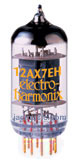
 12AX7 (ECC83) is the most sought after small signal NOS tube, and the Telefunken ECC803S is the legend. Period. Very few companies still make 12AX7, and EHX is one of them. 12AX7 combines all the things that are hard to get.
 Electro Harmonix, how they test 12AX7
12AX7 (ECC83) is the most sought after small signal NOS tube, and the Telefunken ECC803S is the legend. Period. Very few companies still make 12AX7, and EHX is one of them. 12AX7 combines all the things that are hard to get.
It features: High gain, low noise, low power consumption, small size and low microphonics in one product. No need to tell you this is hard, very hard. So this is why ECC83 was expensive while still in regular production in the 1960s. This is why it was never such a widely used tube as 12AT7, and this is why NOS stock is very little. In the world of rare products, everybody wants just that which is not available. So you all want NOS 12AX7, and very few dealers have it.
With new production, the situation is not good also. Tube factories by default use 50 years old machines for 12AX7/ ECC83 , there are no others. Materials like very special alloys, and chemical mixtures are NOT available anymore in the same quality as 50 years ago. You are not allowed to do the blackening process, as it produces dioxine, so plates are now grey coated with all new made tubes. Today, EVERY tube company small or large has it's own strategy to deal with the materials problem.
Those that are specialized on mass production, have only ONE strategy, and that is mass production. That is, just makes as many as you can, as cheap as you can, and during several steps of the production process, kick out the bad products. I know the inside of a tube factory, and there is no other way to overcome the lower quality of base materials. Life would be another if you still could buy exactly this and that special alloy wire, with this and that diameter, and annealing process, specified ductility, on the spool diameter for your machines, virtually no oxide coating on it, and whatever more you need to be as good as Philips and TESLA were in 1960. But today, if you ask material suppliers for that, they don't even understand what it is that you want. Many original materials for tubes production have disappeared, and that's simply it.
One very very small example I give you here is the spool diameter for very fine wire, and it's only a smaller problem. You HAVE to accept the spool diameter for very fine wire, "as is" by the manufacturer. However, your machine only works with spools of it's own diameter, that was normal in the 1950's. However, spooling such a hair-thin wire from one spool on the other will give wire breaks, and the re-spooling by definition will lower the quality of the wire. And there are much larger problems than just that, and these are getting more. If you want them to have a good laugh about you, ask for the wire to be pulled under vacuum, so it stays perfectly clean, same as with the wires the big factories were using 50 years ago. Ask them to pack it in glass pipes, under protective gas. Another laugh will come your way. Last facilities that could to so, were closed in Hanau, Germany, about 15 years ago. Some other materials like excellent getters can be bought sill, but the good functioning of an electron tube is like a chain, and if one piece breaks, the chain is broken.
I have been in communication with EHX chief engineer, JC Morrison about the fact that they ship out the good 12AX7 and the bad ones together. I wondered if I was the only one with a problem. His answer was as simple as can be, and I must say, I never expected this.
July 2008. This information I have received after many phone calls with Electro Harmonix. We needed engineer's guidelines how to test this tube, but we didn't get it. The final answer came from Chief Engineer, JC Morrison. (text not exactly quoted, but the content is) "On a parametric tube tester, you will not see the same test results for this tube, as you would get from NOS tubes. The Electro Harmonic 12AX7-EH needs a different grid voltage, in order to draw the same current as NOS tubes . If you observe this, it is normal. This was done to achieve the EHX typical sound for this tube. It was the result of a lot of research. Test settings are subject to change, and are not published. The tubes are guaranteed to be good, but parametric testing for tube for HiFi purposes must be done by the tube dealers. There are no factory guidelines for this, each tube dealer must do it his own way"
Well that did not help me much, and I can't use this explanation for HiFi tubes. I want tubes that test good on a normal industrial tube tester. Sorry JC Morisson.
Later on, I bought three Amplitrex AT1000 computer controlled tube testers, as far as I know the best from new production. These rejected many of the EHX 12AX7. I send pictures and test data to my contact person of EHX. He asked in the technical department for me, what they thought of it. Their answer was shocking to me. They said, this tube tester they don't know, so test results cannot be trusted. Now hear this... Then they say they have NO test equipment other than a KAYE LABS hand held tester which only tests for gain at a good-bad scale. They send me copies of the KAYE LABS tester, it was no joke. For 10% price adder they can run the tubes on this tester for me. I found this is just a simply hand-held device that guitar players use. It is no HiFi device, and by no means suited to do parametric testing. For the rest, 12AX7 are sold as they come from the factory, AS IS.
So when you buy EHX 12AX7 be aware that all tube dealers are in this situation, but only those that do 100% incoming parametric tests on their tubes, will know. Parametric testing is NOT plug the tube in a Hickok, and get a transconductance value. This is the most common test by USA dealers, but a Hickok tests the tubes at the wrong operating point to begin with, and most of all, it cannot test for correct plate current, which is the MAJOR issue with EHX 12AX7. Just wanted to say so here.