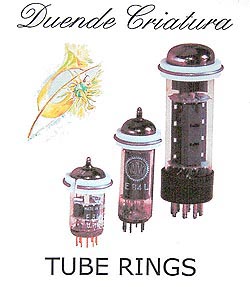
DUENDE CRIATURA TUBE RINGS
the problem - the solution The principle is simple. We all know tubes are microphonic in some way. Microphonics means acoustic coupling exists to the sensitive inside parts of the tube. There are two mechanical paths for that: 1) Direct path: Loudspeakers -> air -> tube glass -> tube mica ->tube plates -> tube grid. And...tube grids are very microphonic, because here is where the signal amplification takes place. The idea with tube dampers is, when you make the tube glass heavier, and also add some damping to it, you'll reduce the microphonic effects. The damping comes from the softness of the Teflon. It seems ideal audio material. 2) Indirect path: Loudspeakers -> air -> amplifier deck -> tube sockets -> tube pins -> tube grid. This type of microphony is best stopped by using the Yamamoto Telfon sockets. So you avoid the mechanical waves to enter the glass. Without Teflon sockets, some good part is still absorbed by tube dampers also. (for Yamamoto, see menu of this website). A problem may also come from mechanical transformer hum, guided through the chassis. Both Teflon sockets, and tube dampers will help against this. The construction The tube dampers are CNC made, in Holland by Duende Criatura. They are made from a solid block of Teflon, with a working temperature of maximum 260°C. This material has no burning effects at all. Teflon is a self-cleaning material, and no dust or colorization will stick to it. They have a spring around them of Titanium, which is a so called "hard metal" and it is surprizingly flexible. Tests I have measured the decay time of the "ring sound" of the Electro Harmonics EL34, when you gently touch the glass with something like a small piece of metal. (see also note3). From the speakers you here: "dinnnng...." It takes around 2 seconds, for 2/3 of the ring noise to be fully gone. The spectrum contains a lot of higher frequencies in the range of 10kHz. When the tube dampers were added to the EL34 tube, the improvement consisted of three things:
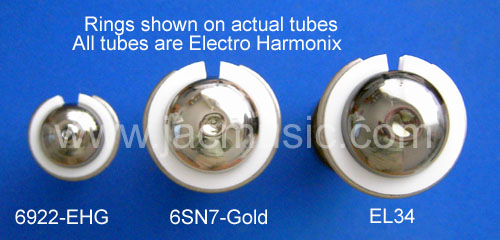
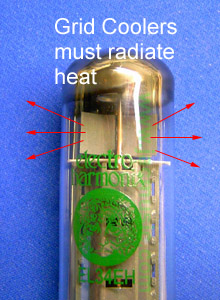
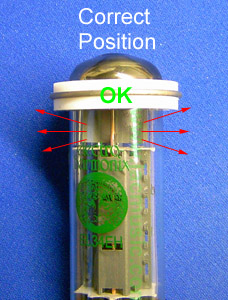
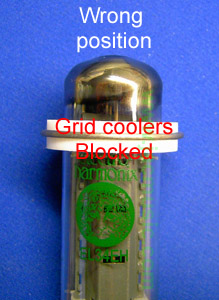
Positioning the tube dampers There is often the concern that tubes get overheated from tube rings. In a way that is true, when you think of bad design constructions that fully cover the tubes. The Duende Criatura is small and relatively heavy, and covers only a small surface at the top of the tube. Interesting, this is the part where the getter is, and it is supposed to be hot, to make the getters work better. (See also note 4) Some other brand tube dampers are placed on the middle of the tube. This is the wrong position, since they obstruct the heat radiation, and can cause severe bias offset of the tube when the grid coolers are covered by them. (See note1) The tubes will be burned out sooner than you expected. You can put these in the Voodoo corner together with non-working medicine, and other magic. I found those covering types are just bad for the tubes. Take the Duende Criatura instead!
Experiences / Testberichte Augusto Sá Monteiro -Spain Martino Sanchez Ruiz - Spain
.
|
|---|
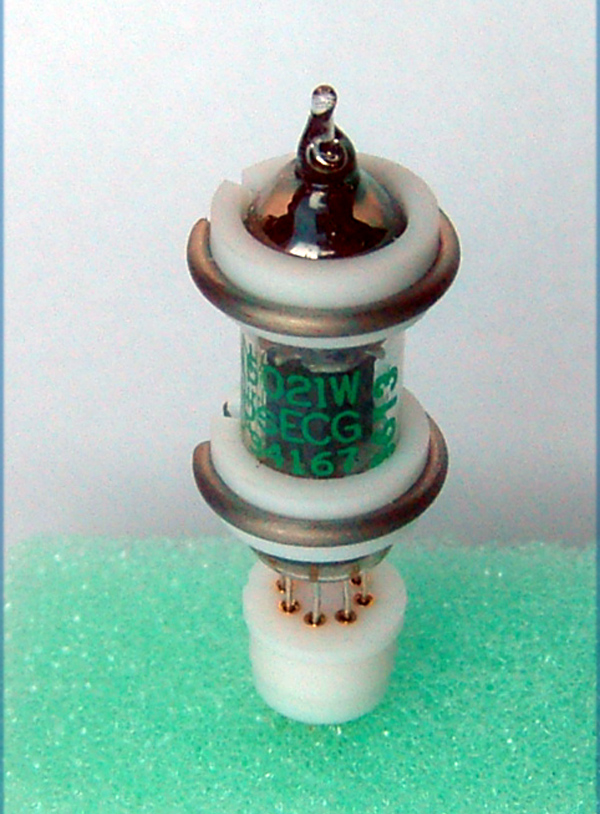 What you see here is one of the "pencil tubes" 6021W, a low noise / small signal tube for high vibration environment. It was made during the cold war in the 1980's. Nuclear explosions destroy all semiconductor electronics in a wide area, like 100km or more. This is why Russian MIG air fighter planes worked entirely on electron tubes. When a nuclear explosion occurs, electron tubes stop working too, but they recover function after the electromagnetic impulse (EMP) is gone. All in theory..... thank God it was never tested. The good part is, there are some stocks of these tubes that the military have started to sell somewhere around 1997. Another typical NOS tube story we have here going on right now. These are PEARLS, sold for low prices until supplies dry up.


