No grounded Deck

DANGER!
|
Safety Issue #1. This the most important one, when you use a Hickock with an 230/115V auto transformer. In the USA, the mains voltage is 115V and in Europe 230V.
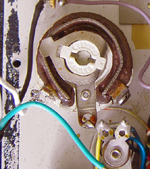
230V is not twice as dangerous as 115V. It is ten times more dangerous. With an electric shock, there are two things that are not so nice. At 230V you can burn your fingers, but I had that so often. The other is, you above 60mA through the heart, it stops beating until you get an injection with insulin. It means if that happens, and you're alone, you're dead after four minutes. For getting that kind of current at 115V you need to do these things like using a hair dryer in the bath tub. At 230V however, all you need to do is touch two metal surfaces with your left and right hand, and 230V in between them. You think that's impossinle? Now with the Hickoks, it is nothing unusual if the mains cord breaks off the potentiometer (see picture). Since the deck plate is not grounded, this will not blow the fuse of your house. You have 50% chance the hot side (230V) touches the deck plate. If by any chance you are leaning on the metal handle of another (properly) grounded instrument it zaps you really bad. It happened to one of my Hickoks, and I realized the danger then. Well I was lucky, this one had a grounded deck plate! The owner before me modified it that way.
So the Hickoks have no grounded deck plate by default, and this is very dangerous. The deck plate is floating, so to say not connected to anything. The isolated deck plate is some kind of safety, but obviously the Hickok and it's safety levels is for 115V only, by 1950's standard, and now the wiring is 60 yeas old, and some of you may be using it at 230V via a transformer. So you have a very dangerous situation here.
Let me tell you why you should always ground the deck plate. The mains cord is connected with one wire, in a very clumsy way to the Rheostat, for the mains control. With some of the testers I have, it broke off already, and I just re soldered it without much thinking about it. The other wire which goes to the switch, is connected a little bit better. It is just a matter of opening the tester up many times, and one of the wire breaks off. Then it may touch the deck plate, and when you use an auto transformer from 230V to 110V... you have a 50% chance that the hot 230V end touches the chassis, depending how your auto transformer is plugged in. So you may be resting with your left hand on the metal plate, when you want to get out the tube you're testing. If at that moment the wire breaks off. you go to tube heaven. Short before the wire is breaking off, it is hanging only on one last and single strand, and your tester will behave funny. So I was trying to find out what's wrong with the tester.
And then it happened to me, and thank GOD, the previous owner had grounded the deck plate, with a new three wire cable. So the "hot" wire of the 230V was grounded at that moment. It blew out the fuse of the whole house. No damage whatsoever to the tester because the hot 230V lead came straight to the grounded deck, not to the inside guts. Only imagine what could have happened. So I can only very much advise you: when you use an auto transformer, NEVER work with Hickok before grounding the deck plate. |
DANGER!
|
Safety Issue #2. This is not a joke! With the bigger models, the mains cord is protected from being pulled out, with a nice metal ring. It works. HOWEVER when you push in the cable, you push in the ring as well. Stupid enough, the position is just below the mains transformer, and if by coincidence you push in the cable more then two inch, you touch the high voltage contacts. So remove that ring, and connect the cable another way.
|
Scale of 750 Tester
|
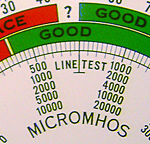
Most Hickoks have in addition to the micromho scale, a so called English scale. Now with they mean with this, is the good/bad scale. The micromho reading for those is what a new tube should read, and the good/bad scale gives the reject point. |
Rectifier test:
|
The Hickok patented circuit for transconduction works amazingly well. The result it not very accurate, but it really picks out any potential bad amplifier tube. (and isn't that what we want?)
HOWEVER..... The rectifier test circuit does NOT test the rectifiers under full load, and SO it can not be good. I found it lets pass bad 5U4G rectifiers, veeeery easily! Don't make a big issue out if this, but be aware that a 50% Emission rectifier passes with a nice green reading on a hickok, but for me 50% emission is "bad". Now such a rectifier will still work, but I think a tester should quality those in the "?" range, and that's not what a Hickok does. |
English scale: |
Some of the larger testers have only the micro mho reading, and no good/bad scale. To allow you to judge a tube for it's quality, they give the reject point on the roll chart, not the value for a new tube. This is very confusing, and causes many mistakes. So the when the 750 says, that 6L6 tube must have 5000micromho, that means a new tube. A used tube may be below that, as long as it tests in the green of the English scale. For those who are interested, I tested this with the two 750A I have, and the reject point on the micromho scale appears to be 4000 micromho on the one and 3500 on the other. This is in-line with the 70% that is used at the real laboratory testers like L3-3, or the better Emission testers like Funke W19. |
Conclusion: |
The micromho readings in the roll chart is not the same, for the above reasons! |
Test signal |
The Hickoks use an AC Test signal, which is connected to the grid of the tube under test. It is obvious that such tubes that need very low grid voltage, can not be tested accurate since these can be fully overdriven. Some the testers like 533, 600 or 605 use a fixed 5Volts AC, which is too much for some tubes. The later 533A, 600A, 605A, 800, 800A used 2.5V, and the more versatile models like 539, 750, 752 used variable voltage from 0.25 to 2.5V depending on the Gm scale you choose. With those testers that have variable test voltage, do the testing only on the sensitivity as indicated on the roll chart for the tube, or you might by mistake be testing the tube in overdrive condition. So if you have to test it on the 15.000 scale, and the reading is too low, the tube just bad, and is not better than that. If you go then to another scale to get more resolution, you may be overdriving the tube, and measure a fully wrong result. |
Spraying contacts |
There are so many warning for this in the internet, saying it can damage the whole switch. Perhaps this is possible, but you have to be so stupid to spray the switch with graphite spray or so. (graphite is a conductor). I never had a tester with damage like this, and think this is a hoax information. I read it on several Hickok sites. Well, I tried various contact cleaning sprays, and never found one that gives the smallest change in isolation resistance. |
Calibrate your Hickok |
My opinion? Here I go the other way. People write on thier website how it can be done, but all I can say is: don't think of it, unless you really really know what you are doing. Don't ask for email support with this. It is too much techno babble. |
Testing 6DJ8 (ECC88) |
This is a difficult tube to test. With some tube testers, like the 600A there were errors on the roll chart, right from the beginning, and never cured. The correct setting for the 600A is 24. Take a pen, and change your roll chart. |
| Tubes not on roll chart |
Getting the latest roll chart makes is worce sometimes. The roll chart had a maximum length to be practical. So in many cases, older tubes had to make room for newer types like TV Tubes. For instance the 27 was removed, because it was already obsolete in 1950. While today it is a nice hifi tube, you need to get the "obsolete tubes" data. It exists for many of the Hickoks. So a "latest" roll chart will give you all those silly TV Tubes, and nice old vintage tubes are removed. |
Sticky meter repair |
Is no problem if you know how. Forget it if you don't know how. I can not say it a better way. |
Open meter repair |
Check if the internal resistor (wire wound spool) has a bad solder joint, or if it is really the meter. When it is the meter, there are sometime slide contacts in there, that have to do with the set screw, on the front panel. You can oil the slide contacts, or just slightly spray the area where the springs are (top and bottom), and after that move the set screw a few times. Open meter spools are harder to repair. leave that up to specialists, but it can be done. Or buy a replacement meter. |
Electrostatic charge |
Careful when polishing the meter plastic cover, this will charge the plastic, and the needle can be heavily deflected, like 15° . After polishing just wait, and it will go away. |
Different results on different testers (1) |
Some testers print the Gm value a new tube should have on the roll chart. For good/bad you must use the English scale. Such testers that don't have the English scale, give the reject point on the roll chart. |
Different results on different testers (2) |
You may not have expected so, but it is normal. What you read on the meter, is NOT to be compared with a tube book, and NOT with other Hickok models too. You must always go by what it says on the roll chart. Only when you have two of the same testers, readings should be within 15%. |
White "rust" powder on chassis. |
Be careful with that white dust layer on some older chassis. I don't know what this is, but I hope it is not cadmium plating. That was thought to be "not so" poisonous, until now we know better. If you have a chassis like that, clean it at a windy day, outside the house. It can be brushed off very well, but don't breath that dust. I don't know what it is. |
50Hz or 60 Hz? |
The Hickoks are made for 60Hz, and not for 50Hz. (Except those with 2x115V on the transformer, like the 539, and the military types can work up to 400Hz. There can be an issue that when working at 50Hz instead of 60Hz, the fuse lamp may start to glow very little when not testing a tube. This should not be the case at 60HZ, but at 50Hz, it can happen. The fact that the fuse lamp reacts differently, tells us the transformer reacts different. It seems to have no very large effect, but you are better off re-calibrating a 60Hz model if you want to use it on 50Hz. |
